
Why Scenarios Matter
Retirement planning involves decisions that are difficult or impossible to reverse. Once you claim Social Security at 62, you cannot unclaim it at 67. Once you retire and leave your employer, going back may not be an option. Once you convert a large sum to Roth and pay the taxes, you cannot undo it.
These decisions interact with each other in complicated ways. Retiring earlier means fewer years of savings contributions, more years of withdrawals, potentially lower Social Security benefits, and a different tax picture. Changing one variable ripples through your entire plan.
Scenarios let you explore these ripple effects safely. Instead of guessing or relying on gut feelings, you can model each alternative with your actual financial data and see the concrete impact on your portfolio, income, and plan success rate. You make the decision with numbers, not nerves.
How Scenarios Work in RetirePlanAI
Full Data Clones
When you create a new scenario, RetirePlanAI makes a complete, independent copy of your entire financial plan. This includes every account balance, every income stream, every expense, every assumption, and every setting. The new scenario starts as an exact duplicate of your primary plan.
This matters because it ensures you are making apples-to-apples comparisons. When you change the retirement age in a scenario, everything else stays identical to your primary plan. The difference in outcomes is purely due to the retirement age change, not because you accidentally used different assumptions.
Once created, each scenario is fully independent. Changes you make in one scenario do not affect your primary plan or any other scenario. You can experiment freely without any risk of corrupting your baseline data.
Up to 20 Scenarios on Paid Plans
Paid subscribers can create up to 20 scenarios. In practice, most users find that three to five active scenarios cover their most important questions, but you are free to create more if your planning situation is complex. Free tier users can create 1 scenario.
Each scenario can be given a descriptive name and notes to help you remember what it represents. "Retire at 62 with part-time consulting" is much more useful than "Scenario 3" when you come back to review your options a week later.
What You Can Change in Each Scenario
Every aspect of your financial plan can be modified independently in each scenario. The most commonly adjusted variables include:
Retirement Timing
- Retirement age: The age at which you stop working and begin drawing on your portfolio. Moving this even one or two years in either direction can have a significant effect on plan success because it simultaneously changes the number of contribution years and the number of withdrawal years.
- Spouse retirement age: If applicable, your spouse's retirement timing can be set independently. Many couples stagger their retirements for income continuity or health insurance coverage.
Spending and Income
- Annual spending goal: Your target spending in retirement, expressed in today's dollars. This is the most powerful lever in any retirement plan. A $5,000 change in annual spending, compounded over a 30-year retirement, can mean a difference of $150,000 or more in total portfolio withdrawals.
- Income sources: Add, remove, or modify any income stream. Model part-time work in early retirement, a deferred pension, or rental income from a property you plan to buy.
- One-time expenses: A major home renovation, helping a child with a down payment, or an extended travel year in early retirement. These large, non-recurring expenses can be added to specific scenarios to see their impact.
- Budget line items: Recurring expenses like healthcare premiums, property taxes, or insurance can be adjusted per scenario.
Investment Assumptions
- Account rates of return: Each account has its own conservative and aggressive rate of return settings, which you can adjust per scenario. Some users create a "conservative" scenario with lower returns to see how their plan holds up if markets underperform.
- Inflation rate: The assumed annual inflation rate. The default is 3%, which is close to the long-term historical average, but you might want to test a 4% scenario given recent inflation trends.
Tax and Withdrawal Strategies
- Roth conversion strategy: Test disabled, conservative (12% bracket), moderate (22% bracket), or aggressive (24% bracket) Roth conversion approaches. Each has different tax implications and different effects on RMDs and long-term portfolio composition.
- IRMAA avoidance: Toggle Medicare surcharge avoidance on or off to see how it affects your Roth conversion schedule and overall tax picture.
- Withdrawal strategy: Compare the classic 4% rule against dynamic withdrawal strategies to see which produces more sustainable or more generous spending.
Account-Level Changes
- Account balances: Adjust starting balances in any scenario. Useful for modeling "What if I save an extra $50,000 before retirement?" or "What if the market drops 20% right before I retire?"
- Contribution amounts: Change how much you contribute to each account in different scenarios. Model maxing out your 401k versus contributing less and paying down a mortgage.
- Portfolio allocation: Adjust ticker allocations and percentages to model different portfolio strategies.
The Comparison View
The real power of scenarios comes from the side-by-side comparison view. This puts your primary plan and one or more scenarios next to each other with key metrics highlighted:
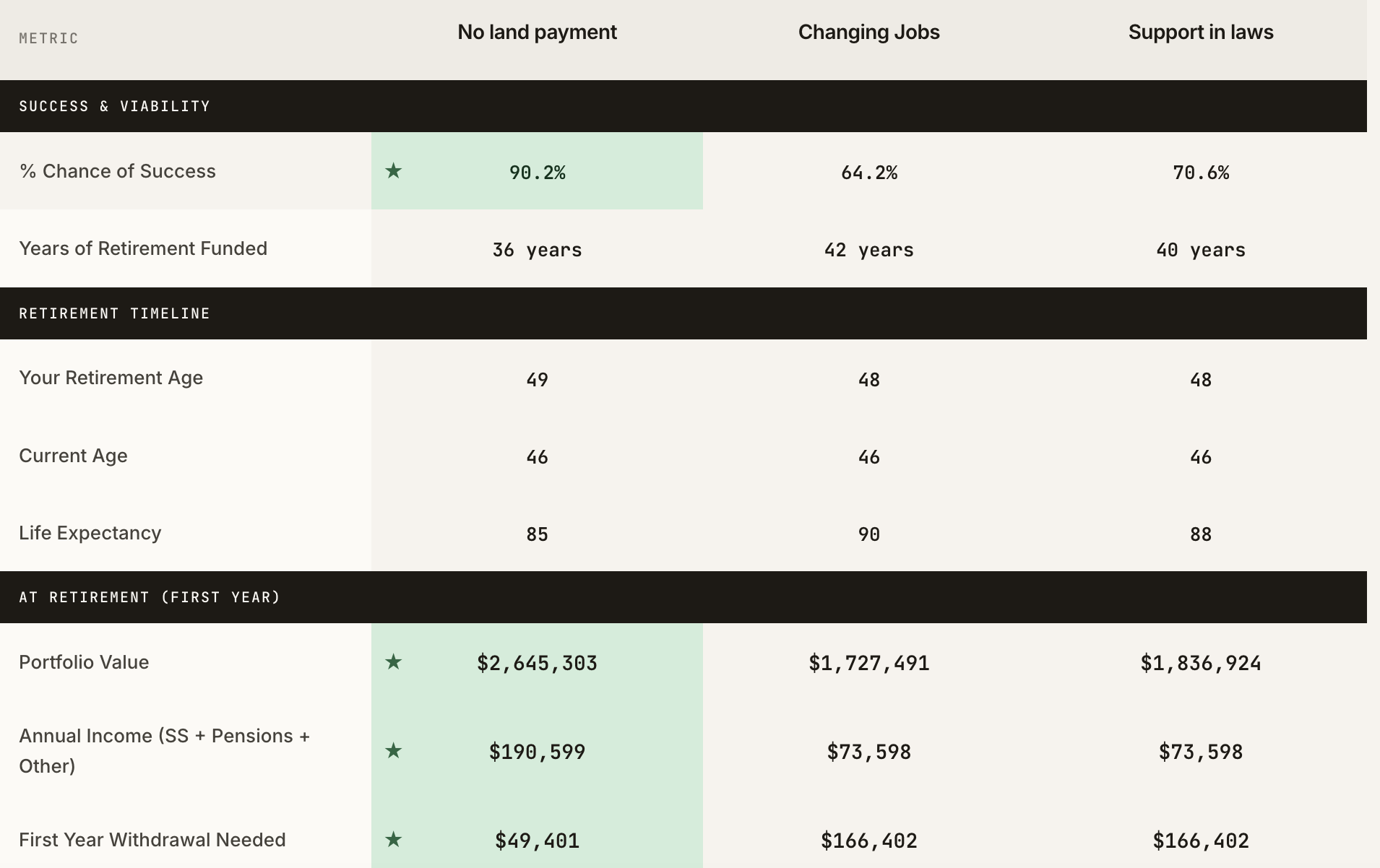
- Success rate: The Monte Carlo probability that your portfolio lasts through retirement.
- Years of retirement funded: How many years your portfolio can sustain withdrawals in the deterministic projection.
- Portfolio value at retirement: The projected portfolio value at your retirement age. This shows how changes in contributions, returns, or retirement timing affect your starting balance.
- Annual income: Your combined income from Social Security, pensions, and other sources.
- First year withdrawal needed: How much you need to draw from your portfolio in the first year of retirement to cover the gap between income and spending.
- Cash flow balance: Your projected portfolio balance at the end of your plan.
- Best-value highlighting: The best metric across scenarios is highlighted with a star so you can quickly spot which scenario performs best in each category.
The comparison view is designed for quick pattern recognition. You should be able to glance at it and immediately understand which scenario produces better outcomes and where the meaningful differences are.
Example Use Cases
Here are the most common scenarios that RetirePlanAI users create, along with what they typically reveal.
"What if I retire at 62 vs. 67?"
This is the most popular comparison. Retiring five years earlier means:
- Five fewer years of salary and 401k contributions (reducing your starting portfolio).
- Five more years of portfolio withdrawals (increasing total lifetime spending from savings).
- Potentially reduced Social Security benefits if you claim early.
- Five additional years of needing private health insurance before Medicare at 65 (if retiring at 62).
The comparison often shows a larger difference than people expect. Five years can represent a 30-40% change in plan success rate depending on your financial situation. But the comparison also reveals whether the gap can be closed through other adjustments, like modest spending reductions or part-time work in the early years.
"What if I increase spending by $10,000 per year?"
This scenario tests the sensitivity of your plan to spending changes. An extra $10,000 per year over a 30-year retirement is $300,000 in additional withdrawals, not counting the lost investment growth on that money. The comparison shows exactly how much this costs in terms of plan success and portfolio longevity.
This comparison is especially useful for couples who disagree about retirement lifestyle. Putting concrete numbers behind the "we should spend more" versus "we should be conservative" discussion often leads to productive compromise.
"What if I convert to Roth aggressively?"
Roth conversions involve paying taxes now to avoid taxes later. The scenario comparison shows:
- How much you would pay in taxes during the conversion years.
- How your Traditional IRA balance decreases and your Roth balance increases over time.
- The reduction in Required Minimum Distributions at age 73 and beyond.
- The net effect on portfolio longevity and plan success.
The "right" answer depends heavily on your current tax bracket, expected future tax bracket, and how much you value leaving tax-free assets to heirs. Scenarios let you see the numbers instead of guessing.
"What if inflation is higher than expected?"
After the 2021-2023 inflation spike, many planners are testing whether their plan can handle persistently higher inflation. Create a scenario with 4% or 4.5% inflation instead of the default 3% and compare the results.
Higher inflation erodes purchasing power, which means your fixed-dollar income sources (like many pensions) cover less of your spending over time. It also means your spending goal, expressed in today's dollars, requires increasingly larger nominal withdrawals. The scenario comparison quantifies this effect precisely.
"What if the market drops 25% right before I retire?"
Create a scenario where your account balances are 25% lower. This is a crude but effective way to stress-test against retiring into a bear market. If your plan still works (or nearly works) with a 25% haircut, you have a meaningful margin of safety. If it fails, you know you need a contingency plan for that possibility.
"What if one of us gets a part-time job for five years?"
Add an income stream of $25,000 to $40,000 per year from age 62 to 67 in one scenario. This is one of the most impactful adjustments many pre-retirees can make, and the scenario comparison often shows a surprisingly large improvement in plan success. Even modest part-time income in the early retirement years reduces portfolio withdrawals during the critical sequence-of-returns window.
Managing Your Scenarios
Naming and Organization
Give each scenario a descriptive name that captures the key difference from your primary plan. Good names:
- "Retire at 62, part-time to 67"
- "Conservative returns (5% pre, 4% post)"
- "Aggressive Roth conversion"
- "Downsize house at 70"
You can also add notes to each scenario to record your reasoning or observations. These notes are useful when you return to compare scenarios weeks or months later.
Setting a New Primary Plan
If you create a scenario that you prefer over your current primary plan, you can promote it. Setting a scenario as your primary plan makes it the new baseline for your dashboard, projections, and AI Coach conversations. Your old primary plan becomes a regular scenario that you can keep for reference or delete.
Iterating on Scenarios
Scenarios are most powerful when used iteratively. A common pattern:
- Create a scenario that tests a single change (e.g., retire at 62 instead of 65).
- See that the success rate drops from 88% to 71%.
- Create a second scenario: retire at 62, but add part-time work of $30,000/year for three years.
- See that the success rate recovers to 83%.
- Create a third scenario: retire at 62, part-time work for three years, and reduce spending by $3,000/year.
- See that the success rate reaches 89%.
This iterative approach helps you find the combination of adjustments that gets you to your desired retirement date with an acceptable level of risk. Each iteration is informed by the concrete results of the previous one.
Common Pitfalls to Avoid
- Changing too many variables at once. If you change the retirement age, spending, return assumptions, and Roth strategy all in one scenario, you cannot tell which change is responsible for the different outcome. Change one or two variables per scenario for clearer insights.
- Forgetting to update all related inputs. If you change your retirement age from 65 to 62, remember to also update related inputs like Social Security claiming age, pension start date, or the end date of employer health insurance. Scenarios clone your data exactly, so downstream inputs do not automatically adjust.
- Comparing stale scenarios. If you update your account balances in your primary plan but not in your scenarios, the comparison is misleading. When you update balances, either recreate your scenarios or update them to match.
- Over-optimizing on success rate alone. A scenario with a 95% success rate but $20,000 less annual spending may not be "better" than a scenario with 85% success rate and a more comfortable lifestyle. Success rate is one metric, not the only one. Consider quality of life alongside portfolio durability.
Scenarios and the AI Coach
The AI Coach can see your scenarios and their results. This makes it a useful partner for interpreting comparisons. You can ask questions like:
- "Looking at my retire-early and retire-at-67 scenarios, what is the single most impactful change I could make to close the gap?"
- "Based on my scenarios, is part-time work or spending reduction more effective for improving my success rate?"
- "Which of my scenarios has the best balance of spending level and plan safety?"
The AI Coach can analyze the differences between your scenarios, identify which variables are driving the outcome differences, and suggest further scenarios you might want to test.