
Why Stock Compensation Matters for Retirement
If you work in tech or another industry that grants equity compensation, your RSUs (Restricted Stock Units) may represent a substantial portion of your total compensation and future wealth. Many people focus on their 401(k) and IRA balances but overlook the value of unvested RSUs when planning for retirement.
RSU vesting creates a stream of future income that can fund retirement contributions, bridge the gap to Social Security, or provide a financial cushion in early retirement. But this income has a defined end date -- once your grants fully vest, that income stops. RetirePlanAI models your vesting schedule so your projections account for this income accurately, including when it starts, when it ends, and how much tax is withheld.
What You Enter for Each Grant
For each RSU grant, you provide the following information:
- Company name and stock ticker: Identifies the grant (e.g., "Acme Corp" / "ACME").
- Grant date: When the grant was awarded.
- Total shares: The total number of shares in the grant.
- Share price at grant: The stock price when the grant was awarded. This is for your reference only and is not used in projections.
- Current share price: The stock price used for all vesting calculations and projections. This is the number that drives your projected income.
- Vesting start date: When vesting begins (may differ from grant date).
- Vesting duration: The total vesting period in months (e.g., 48 months for a 4-year grant).
- Vesting frequency: How often shares vest -- monthly, quarterly, or annually.
- Cliff period: The number of months before any shares vest (0 to 36 months). No shares vest during the cliff. After the cliff, vesting proceeds on the normal schedule.
- Vesting schedule type: Linear (shares vest evenly) or custom (you specify the percentage that vests each year).
- Grant status: Actual (already received) or forecasted (expected future grant).
- Stops at retirement: Whether unvested shares are forfeited when you retire. This is checked by default, since most employers do not continue vesting after you leave.
- Tax withholding rate: The percentage withheld at vesting for taxes. The default is 22%, which is the standard federal supplemental income withholding rate.
Vesting Schedule Types
Linear Vesting
With linear vesting, shares vest evenly across the entire vesting duration. For a 4-year grant with 1,000 shares:
- Monthly vesting: Approximately 21 shares vest each month (1,000 / 48 months).
- Quarterly vesting: 62.5 shares vest each quarter (1,000 / 16 quarters).
- Annual vesting: 250 shares vest each year (1,000 / 4 years).
Linear vesting is the most common schedule at most companies. It provides a steady, predictable stream of income.
Custom Vesting
Some companies use non-uniform vesting schedules. The most well-known example is Amazon's back-loaded schedule, where a smaller percentage vests in years one and two, and a larger percentage vests in years three and four.
With custom vesting, you specify the percentage of shares that vest each year. The percentages must add up to 100%. For example:
- Year 1: 5%
- Year 2: 15%
- Year 3: 40%
- Year 4: 40%
Within each year, shares are distributed based on your vesting frequency. If you select quarterly vesting with 40% vesting in year 3, that 40% is split across four quarters.
Cliff Periods
A cliff period delays all vesting until a certain number of months have passed. A common pattern is a 1-year cliff with 4-year vesting: no shares vest for the first 12 months, then vesting proceeds normally for the remaining 3 years.
If you leave the company during the cliff period, you forfeit all shares in that grant. This is an important consideration for retirement timing -- if you have a grant approaching its cliff date, waiting a few extra months to retire could mean the difference between receiving or forfeiting a significant number of shares.
Actual vs. Forecasted Grants
RetirePlanAI distinguishes between two types of grants:
- Actual grants: RSUs you have already received from your employer. These are real, documented grants with known terms. They appear with a green badge on your dashboard.
- Forecasted grants: RSUs you expect to receive in the future, such as annual refresh grants. These are estimates based on your compensation expectations. They appear with a yellow badge to remind you they are projections, not confirmed.
Both types are included in your retirement projections. Forecasted grants are useful for modeling expected future compensation, but remember to update them as actual grants are received.
How RSU Income Appears in Your Plan
Vesting Income in Projections
Each year that shares vest, RetirePlanAI adds the after-tax vesting income to your cash flow projections. The calculation is straightforward:
Annual vesting income = shares vesting that year x current share price x (1 - tax withholding rate)
For example, if 250 shares vest in a year, the current share price is $150, and your tax withholding rate is 22%:
- Gross vesting value: 250 x $150 = $37,500
- Tax withholding: $37,500 x 22% = $8,250
- After-tax income: $37,500 - $8,250 = $29,250
This $29,250 flows into your projections as income for that year, reducing the amount you need to withdraw from your portfolio.
Retirement Age Cutoff
If "stops at retirement" is enabled (the default), unvested shares after your retirement age are excluded from projections. This reflects the reality that most employers cancel unvested RSUs when you leave the company.
This is an important planning consideration. If you are 58 and receive a 4-year grant, only the shares that vest before your retirement age will count in your plan. If you plan to retire at 60, you would only receive about 2 years of vesting from that grant.
Stock Price Assumptions
RetirePlanAI uses your entered current share price for all future vesting calculations. The price is held constant -- the tool does not project stock price growth or decline. This is a deliberate design choice: predicting individual stock prices is unreliable, and using the current price gives you a conservative, grounded estimate.
If you believe the stock will appreciate significantly, you can enter a higher estimated price. If you want a conservative projection, use the current price or even a lower one. You can also create what-if scenarios with different share prices to see how stock performance affects your plan.
RSU Dashboard
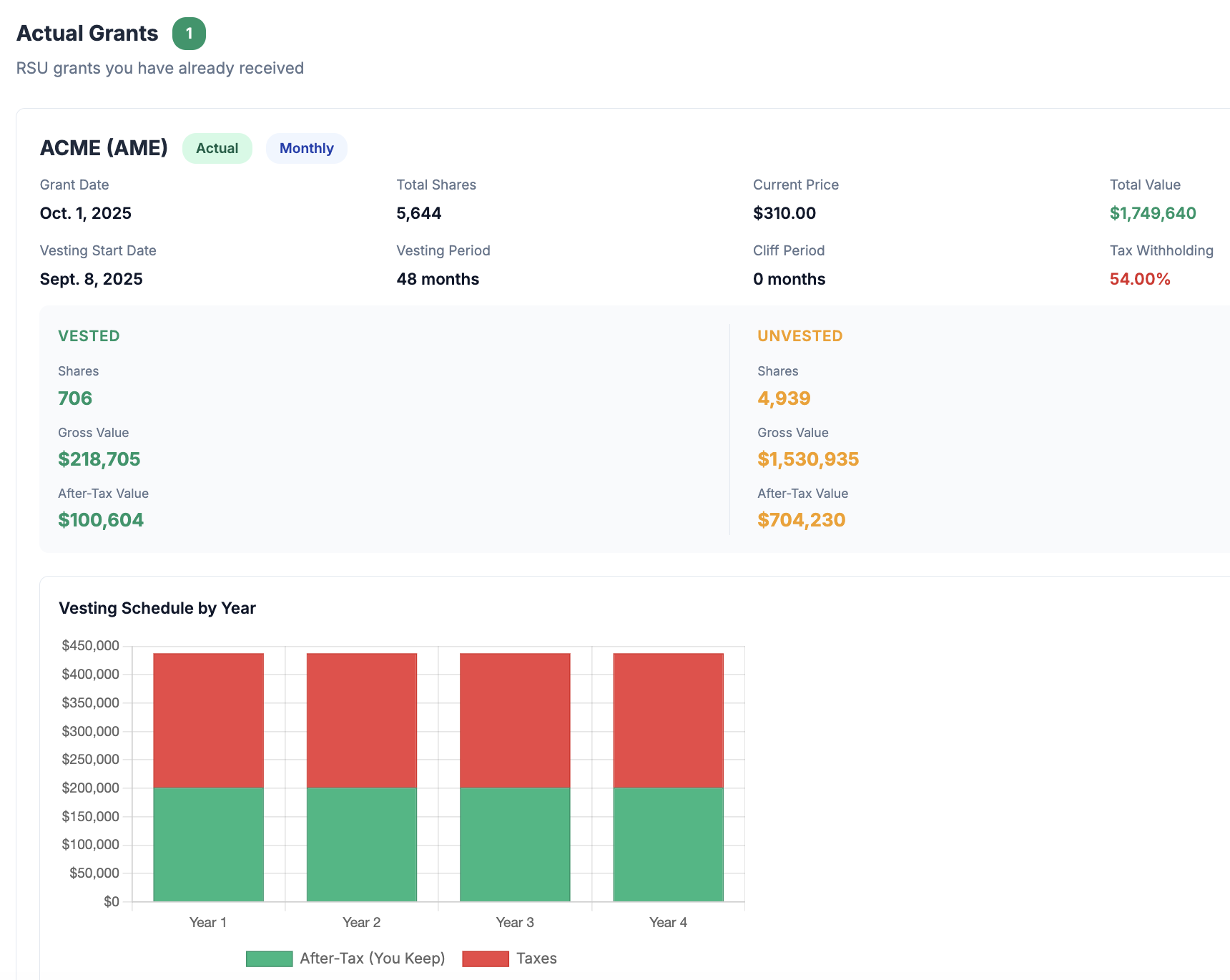
Your RSU dashboard provides a complete view of your stock compensation:
- Summary totals: Combined gross and after-tax values across all grants, broken down by actual vs. forecasted, and vested vs. unvested.
- Per-grant details: Each grant shows its terms, vesting progress, and a year-by-year bar chart of projected vesting income (gross and tax split).
- Total pipeline: The combined value of everything -- vested, unvested, actual, and forecasted -- so you can see the full picture of your stock compensation.
RSUs and Scenarios
When you add an RSU grant, it is automatically copied to all of your what-if scenarios. This ensures your scenarios start from the same baseline. You can then modify grants independently in each scenario -- for example, testing what happens if you receive a larger refresh grant or if the stock price drops 20%.
When editing a grant, you have the option to sync changes across all scenarios or update just the current one.
Tax Considerations
RSU vesting is treated as ordinary income for federal tax purposes. The default 22% withholding rate is the standard federal supplemental income rate, but your actual tax liability may be higher or lower depending on your total income and tax bracket.
RetirePlanAI applies tax withholding at the time of vesting in its projections. This means the income that flows into your cash flow is the after-tax amount. The tool does not model:
- State income tax on RSU vesting (varies by state)
- Additional Medicare or Social Security taxes on high earners
- Capital gains tax if you hold shares after vesting and sell later at a different price
- Tax lot management or specific identification for share sales
For significant RSU grants, consider consulting a tax professional to understand your full tax picture, especially if you live in a high-tax state like California or New York.
Tips for RSU Planning
- Update your share price regularly. Since the tool uses a static price, keeping it current gives you the most accurate projections. Update it monthly or whenever there is a significant price change.
- Add forecasted grants for refresh grants. If your company gives annual refresh grants, add a forecasted grant with your expected terms. This helps your projections capture income that would otherwise be missing.
- Check your cliff dates before setting a retirement date. If you have a grant approaching its cliff, retiring a few months early could mean forfeiting a significant amount. Run the numbers in a scenario to see if waiting is worth it.
- Consider the retirement cutoff carefully. If you plan to negotiate a later departure date or transition to part-time, you might uncheck "stops at retirement" for grants that will continue vesting. Only do this if you are confident the vesting will actually continue.
- Use scenarios to test stock price sensitivity. Create one scenario with your current price and another with a 20-30% lower price. If your retirement plan depends heavily on RSU income at today's prices, you may want a backup plan.