
What Is a Roth Conversion?
A Roth conversion moves money from a Traditional (tax-deferred) retirement account into a Roth (tax-free) account. The converted amount is added to your taxable income in the year of conversion, meaning you pay income tax on it now. In exchange, that money and all of its future growth can be withdrawn completely tax-free in retirement.
The basic tradeoff is straightforward: pay taxes today at a known rate to avoid paying taxes later at an unknown rate. Whether this tradeoff works in your favor depends on several factors, including your current tax bracket, your expected future tax bracket, the time the money has to grow tax-free, and whether you have other resources to pay the tax bill without dipping into the converted funds.
Roth conversions are not a universally good idea. They are a tax timing strategy. They are most beneficial when you can convert at a lower tax rate than you would otherwise pay on withdrawals. They are least beneficial (and potentially harmful) when you convert at a high rate and would have withdrawn at a lower rate.
Why Roth Conversions Matter for Retirement Planning
Even if you are not sure whether conversions make sense for you, understanding how they work is important because they intersect with several critical retirement planning topics.
Required Minimum Distributions (RMDs)
Starting at age 73, the IRS requires you to withdraw a minimum amount from Traditional retirement accounts each year, whether you need the money or not. These withdrawals are taxed as ordinary income. The amount is based on your account balance and life expectancy, and it increases each year as a percentage of your balance.
For people with large Traditional IRA or 401k balances, RMDs can push them into higher tax brackets and trigger Medicare surcharges. Every dollar you convert to Roth before age 73 is a dollar that will never be subject to RMDs. Converting strategically in the years between retirement and age 73, when your income may be lower, can significantly reduce the RMD burden.
Tax Bracket Management
Most retirees experience a period of lower income between when they stop working and when Social Security and RMDs begin. This creates a window of opportunity where the tax brackets are partially empty. Roth conversions can fill those brackets at a lower tax rate than the money would face later.
For example, if your taxable income in the year after retirement is $40,000, there is room to convert additional funds and stay within the 12% or 22% bracket, depending on your filing status. Without the conversion, that same money might be forced out as RMDs when your total income pushes you into the 24% or 32% bracket.
Tax-Free Legacy
Roth IRAs pass to heirs tax-free. Beneficiaries must withdraw the funds within 10 years (under current rules), but they owe no income tax on the withdrawals. Inherited Traditional IRAs, by contrast, are taxed as ordinary income to the beneficiary. For people who want to leave assets to the next generation, Roth conversions effectively prepay the tax so heirs receive the full value.
How RetirePlanAI Models Roth Conversions
Four Conversion Strategies
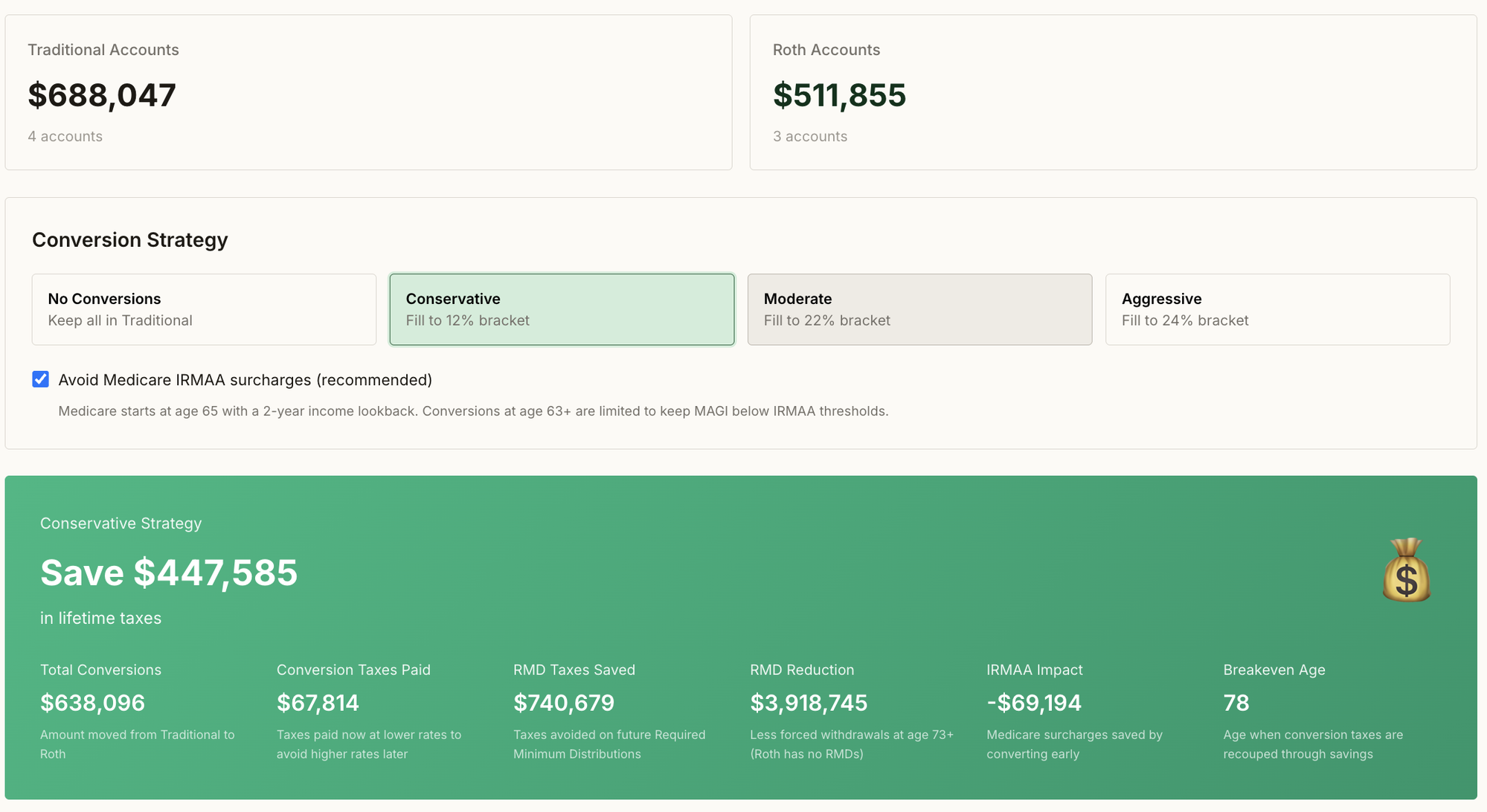
RetirePlanAI offers four predefined Roth conversion strategies, each based on the concept of tax-bracket filling. This means the tool calculates how much income you already have in a given year, then converts just enough from Traditional to Roth to fill up to a target tax bracket ceiling, without going over.
- Disabled: No Roth conversions are modeled. Your Traditional accounts stay as they are, and RMDs are calculated normally starting at age 73. Use this as your baseline for comparison.
- Conservative (12% bracket): Converts enough each year to fill up to the top of the 12% federal tax bracket. This is the most cautious approach, keeping conversions at a low tax cost. The annual conversion amounts are typically modest, which means it takes longer to move a meaningful portion of your Traditional balance to Roth. Best for people who are confident their future tax rate will be at least 12%, or who want to minimize the annual tax impact.
- Moderate (22% bracket): Fills up to the top of the 22% bracket. This is the most popular strategy because the jump from 12% to 22% is relatively small, but the jump from 22% to 24% is significant in terms of the bracket width. Moderate conversions move more money to Roth each year, which accelerates the RMD reduction benefit. This strategy works well for middle-income retirees who expect to be in the 22-24% bracket during RMD years.
- Aggressive (24% bracket): Fills up to the top of the 24% bracket. This converts the most money each year, paying a higher tax rate on some of the conversion. The benefit is that it moves the most money into tax-free status in the shortest time. This strategy makes sense for people with large Traditional balances who would face 32% or higher tax rates on future RMDs, or who have a strong desire to maximize their tax-free legacy.
How Bracket Filling Is Calculated
For each year of your plan, RetirePlanAI calculates your conversion amount with the following process:
- Calculate other income. Add up all non-conversion taxable income for the year: Social Security benefits (the taxable portion), pension income, part-time wages, investment income, and any other sources.
- Determine available bracket space. Look up the chosen bracket ceiling for your filing status, then subtract your other income. The result is the maximum conversion amount that stays within the target bracket.
- Check Traditional balance. If your remaining Traditional balance is less than the available bracket space, convert the entire remaining balance. There is no point converting more than you have.
- Apply IRMAA limits. If IRMAA avoidance is enabled and you are within the lookback window (see below), reduce the conversion to avoid triggering Medicare surcharges.
- Execute the conversion. Move the calculated amount from Traditional accounts to Roth accounts, and add the conversion amount to taxable income for that year.
This process repeats for every year from your current age (or retirement age, depending on when you start conversions) through the age when your Traditional balance reaches zero or RMDs begin.
IRMAA Cliff Avoidance
IRMAA stands for Income-Related Monthly Adjustment Amount. It is a surcharge that Medicare adds to your Part B and Part D premiums if your income exceeds certain thresholds. The surcharges are structured as cliffs, not gradual slopes. One dollar over a threshold can cost you thousands in additional premiums.
Why IRMAA Matters for Roth Conversions
Roth conversions add to your Modified Adjusted Gross Income (MAGI). A large conversion can push your MAGI over an IRMAA threshold, triggering surcharges that partially offset the tax benefit of the conversion. In some cases, the IRMAA cost can make the conversion a net negative for that year.
The Two-Year Lookback Rule
IRMAA is based on your income from two years prior. If you are 67, Medicare looks at your income from when you were 65 to determine your current surcharge. This means Roth conversions at age 63 can affect your Medicare premiums at age 65, when you first enroll.
RetirePlanAI implements this lookback rule automatically. When IRMAA avoidance is enabled, the tool starts monitoring your conversion amounts at age 63 (two years before Medicare eligibility at 65). From age 63 onward, conversions are automatically reduced or blocked if they would cause your MAGI to exceed the first IRMAA threshold in any lookback-affected year.
How It Appears in Your Plan
The Roth conversion schedule in RetirePlanAI shows each year's planned conversion amount. When IRMAA avoidance reduces or blocks a conversion, the tool flags that year so you can see exactly when and why the conversion was limited. This transparency lets you make an informed decision about whether to keep IRMAA avoidance enabled or override it.
You might choose to disable IRMAA avoidance if the long-term tax savings from a larger conversion outweigh the two or three years of Medicare surcharges. This is a judgment call that depends on your specific numbers, and the scenario comparison feature is well suited for testing both options side by side.
Understanding the Roth Conversion Outputs
When you enable a Roth conversion strategy, RetirePlanAI generates several outputs to help you understand the impact.
Year-by-Year Conversion Schedule
A table showing each year's conversion: your age, the conversion amount, the remaining Traditional balance after conversion, and the resulting Roth balance. You can see exactly how much is being moved each year and how quickly your Traditional balance draws down.
This schedule is useful for tax planning with your accountant. If you decide to implement conversions, this table gives you a year-by-year roadmap of target conversion amounts.
Traditional vs. Roth Balance Projections
A chart showing the projected balances of your Traditional and Roth accounts over time. Without conversions, your Traditional balance typically grows steadily until RMDs force it down. With conversions, you see the Traditional balance decline earlier and more gradually, while the Roth balance grows.
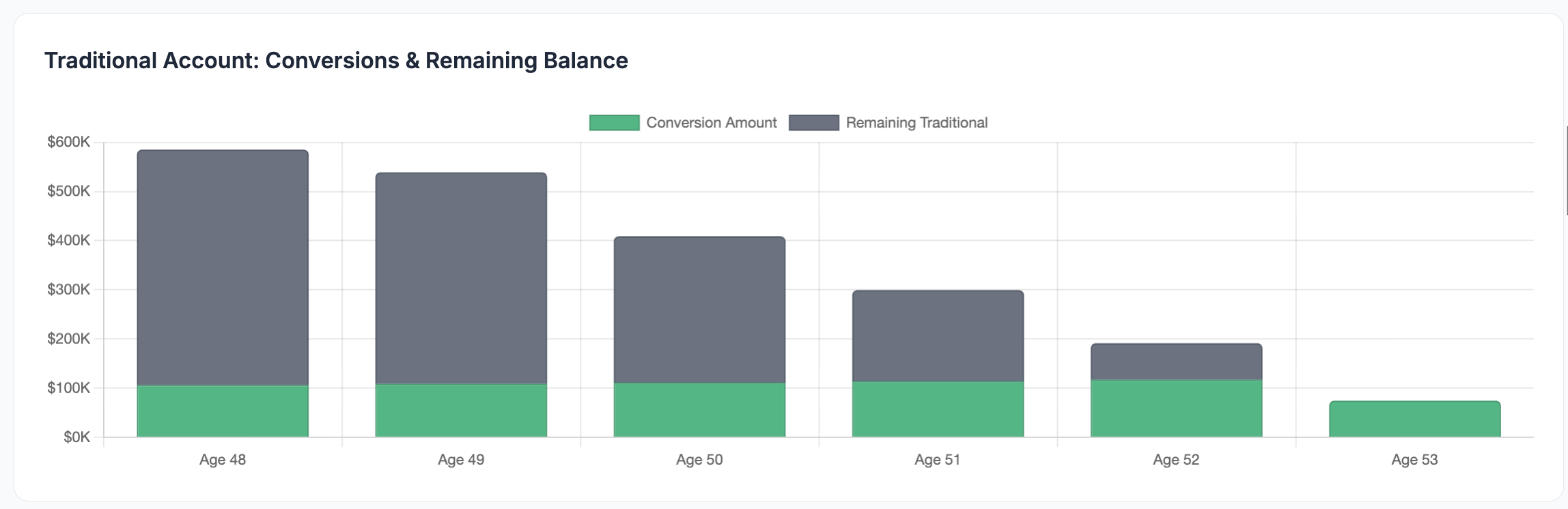
The crossover point, where Roth assets exceed Traditional assets, is often illuminating. It shows roughly when the conversion strategy has moved the majority of your tax-deferred money into tax-free status.
RMD Reduction Analysis
Since RMDs are based on your Traditional account balance, every dollar converted to Roth is a dollar that does not generate future RMDs. RetirePlanAI shows the projected RMD amounts with and without conversions, so you can see exactly how much the conversion strategy reduces your mandatory withdrawals.
For people with large Traditional balances (over $1 million), the RMD reduction can be dramatic. Without conversions, RMDs at age 80 might be $80,000 or more per year, pushing you into higher tax brackets. With an aggressive conversion strategy, those same RMDs might be $30,000 or less.
Which Accounts Are Included
RetirePlanAI tracks all Traditional (tax-deferred) account types for conversion analysis:
- Traditional IRA
- Spouse Traditional IRA
- 401(k)
- Spouse 401(k)
- 403(b)
- 457
- Other Tax-Deferred
Funds from these accounts are modeled as converting into your Roth IRA (or Spouse Roth IRA). The tool aggregates all Traditional balances for the bracket-filling calculation and models conversions against the combined total.
Note that 401(k), 403(b), and 457 accounts at a current employer typically cannot be converted while you are still employed. The conversion modeling assumes these accounts become eligible for conversion at retirement (via rollover to a Traditional IRA). If you have already separated from a prior employer, those accounts can be rolled over and converted at any time.
When Roth Conversions Make Sense
There is no single answer, but the following situations generally favor Roth conversions:
- You have a gap between retirement and RMDs. If you retire at 60 or 62 and your Social Security does not start until 67 or 70, you may have several years of unusually low taxable income. Filling the lower brackets during these years is almost always beneficial.
- Your Traditional balance is large relative to your spending. If you have $2 million in Traditional accounts and spend $80,000 per year, your RMDs will eventually far exceed your spending needs, creating a tax burden you cannot avoid. Conversions reduce this problem.
- You expect higher future tax rates. Whether from personal income changes (RMDs, Social Security, pension) or legislative changes (current tax brackets are scheduled to expire after 2025), if you believe future rates will be higher, paying taxes now at today's rates is advantageous.
- You want to leave tax-free assets to heirs. Roth IRAs are among the most tax-efficient assets to inherit. If legacy planning is a priority, conversions make the inheritance more valuable to your beneficiaries.
- You can pay the conversion tax from non-retirement funds. If you have a taxable brokerage account or savings that can cover the tax bill, you avoid reducing your retirement account balances. Paying the tax from the converted funds themselves reduces the benefit.
When Roth Conversions May Not Make Sense
Conversions are less beneficial or potentially counterproductive when:
- You are already in a high tax bracket. If your current income puts you in the 32% or 35% bracket, converting and paying taxes at that rate only makes sense if you are confident about facing an even higher rate later.
- Your Traditional balance is modest. If your RMDs will be small and will not push you into a higher bracket, the tax drag is minimal and the conversion may not be worth the complexity and upfront tax cost.
- You need the money soon. Converted funds must stay in the Roth for five years to avoid penalties on earnings (the "five-year rule"). If you might need to withdraw the converted funds within five years, conversions are less attractive.
- You expect significantly lower income in retirement. If your retirement spending will be modest and your income sources are small, you might withdraw from Traditional accounts at a lower tax rate than what you would pay on conversions now.
- The conversion would trigger IRMAA surcharges that outweigh the benefit. This is where the IRMAA avoidance feature is most useful. Run the comparison with and without avoidance to see the net impact.
Using Scenarios to Test Conversion Strategies
The most effective way to evaluate Roth conversions in RetirePlanAI is to create multiple scenarios:
- Your primary plan with conversions disabled (baseline).
- A scenario with conservative conversions (12% bracket).
- A scenario with moderate conversions (22% bracket).
- Optionally, a scenario with aggressive conversions (24% bracket).
Compare the scenarios side by side. Look at the portfolio at retirement, the depletion age, the RMD projections, and the Monte Carlo success rate for each. The scenario that produces the best combination of outcomes for your specific situation is the one to pursue.
Remember that the "best" strategy is not necessarily the one with the highest success rate. It is the one that best balances tax efficiency, portfolio longevity, lifestyle flexibility, and legacy goals given your personal values and priorities.
Important Limitations
RetirePlanAI models the financial impact of Roth conversions, but there are important things it does not do:
- It does not execute conversions for you. The tool produces a conversion schedule and analysis. To actually convert, you need to contact your brokerage (Fidelity, Schwab, Vanguard, etc.) and initiate the conversion there.
- It does not provide tax advice. Tax law is complex and situation-specific. The bracket-filling model is a useful approximation, but it does not account for every possible tax deduction, credit, or special situation that might affect your actual tax bill. Work with a tax professional, especially for large conversions.
- State taxes are not included. The conversion analysis uses federal tax brackets only. State income taxes are not modeled, so your actual tax cost may be higher if you live in a state with income tax.
- It uses current tax brackets. If Congress changes the tax brackets (the 2017 Tax Cuts and Jobs Act provisions are currently scheduled to sunset after 2025), the conversion analysis would need to be updated. RetirePlanAI will update its models as tax law changes, but projections far into the future are inherently uncertain.
Despite these limitations, the Roth conversion planner provides a structured, quantitative framework for thinking through a decision that many retirees face. It is significantly better than guessing, and the scenario comparison feature lets you test the sensitivity of your decision to different assumptions.