
For most American households, Social Security is the single largest source of retirement income. The decision of when to claim benefits -- which you can do at any age from 62 to 70 -- is one of the highest-stakes financial decisions you will make, potentially worth hundreds of thousands of dollars over your lifetime. This guide explains how benefits are calculated, how the claiming age decision works, and how RetirePlanAI's optimizer helps you find the best strategy for your household.
The Basics: How Social Security Benefits Are Calculated
Your Social Security benefit is based on your highest 35 years of earnings, adjusted for wage inflation. The Social Security Administration (SSA) uses these earnings to calculate your Primary Insurance Amount (PIA), which is your monthly benefit at Full Retirement Age (FRA). If you have fewer than 35 years of earnings, zeros are averaged in, which reduces your benefit.
Full Retirement Age (FRA)
Your FRA depends on when you were born:
- Born 1943-1954: FRA is 66
- Born 1955: FRA is 66 and 2 months
- Born 1956: FRA is 66 and 4 months
- Born 1957: FRA is 66 and 6 months
- Born 1958: FRA is 66 and 8 months
- Born 1959: FRA is 66 and 10 months
- Born 1960 or later: FRA is 67
FRA is important because it is the baseline around which early and delayed benefits are calculated. It is not the age you "should" claim -- it is simply the reference point.
How Benefits Change Based on Claiming Age
You can claim Social Security as early as age 62 or as late as age 70. The age you choose permanently adjusts your monthly benefit:
Claiming Before FRA (Age 62 to FRA)
For each month you claim before FRA, your benefit is permanently reduced. The reduction is approximately 6.67% per year for the first three years before FRA, and 5% per year for additional years before that. For someone with an FRA of 67, claiming at 62 means a roughly 30% reduction in monthly benefits compared to waiting until FRA.
Example: If your FRA benefit would be $2,000 per month, claiming at 62 would give you approximately $1,400 per month. That reduction is permanent -- it does not go back up when you reach FRA.
Claiming After FRA (FRA to Age 70)
For each year you delay past FRA, your benefit increases by 8% per year through delayed retirement credits. This continues until age 70, after which there is no further increase. An 8% guaranteed annual increase is difficult to match with any other investment.
Example: If your FRA benefit at 67 is $2,000 per month, waiting until 70 would give you $2,480 per month -- a 24% increase. Over 20 years of retirement, that extra $480 per month adds up to over $115,000 in additional income, before accounting for annual cost-of-living adjustments.
The Tradeoff in Plain Terms
Claiming early means smaller checks for more years. Claiming late means bigger checks for fewer years. The question is: at what point does the person who waited catch up to and overtake the person who claimed early? That crossover point is called the break-even age.
Break-Even Analysis
Break-even analysis compares the cumulative benefits received under different claiming ages. For a typical comparison of claiming at 62 versus 70:
- The early claimer collects 8 additional years of (smaller) payments
- The late claimer starts with a benefit that is roughly 77% higher
- The break-even age is typically around 80 to 81
If you live past the break-even age, delaying was the better financial choice. If you do not, claiming early would have provided more total income. Since the average 65-year-old in the United States can expect to live into their mid-80s, delaying benefits is often -- but not always -- advantageous from a pure dollars standpoint.
RetirePlanAI's Social Security Optimizer helps you evaluate this tradeoff by calculating total lifetime income for every claiming age combination, using your specific benefit amounts rather than generic estimates.
Spousal Benefits and Household Coordination
If you are married, Social Security optimization becomes significantly more complex because you are coordinating two claiming decisions. Both you and your spouse can have your own benefits, and the optimal strategy often involves one spouse claiming at a different age than the other.
How Spousal Coordination Works
Each spouse can claim their own benefit at any age between 62 and 70. The optimal household strategy depends on both benefit amounts, both ages, and life expectancy assumptions. Common coordination patterns include:
- Higher earner delays to 70, lower earner claims early: This is often the strongest strategy because the higher benefit gets the maximum delayed retirement credits, providing the best longevity insurance. The lower earner's early claim provides income during the bridge years.
- Both delay to 70: Maximizes total benefits if both spouses live into their mid-80s or beyond, but requires more portfolio withdrawals during the bridge years.
- Both claim at FRA: A moderate approach that balances early income with reasonable benefit levels.
- Both claim at 62: Maximizes early income and minimizes portfolio withdrawals, but results in the lowest lifetime income if both spouses live past their early 80s.
RetirePlanAI's Social Security Optimizer
The Social Security Optimizer in RetirePlanAI takes a comprehensive, brute-force approach to finding your best strategy. Here is what it does:
Tests Every Valid Combination
For a couple, the optimizer tests all combinations of claiming ages -- user age 62 through 70 and spouse age 62 through 70. That is 81 possible combinations (9 options for each person). For a single person, it tests all 9 claiming ages. Each combination is evaluated using your specific benefit amounts and age information.
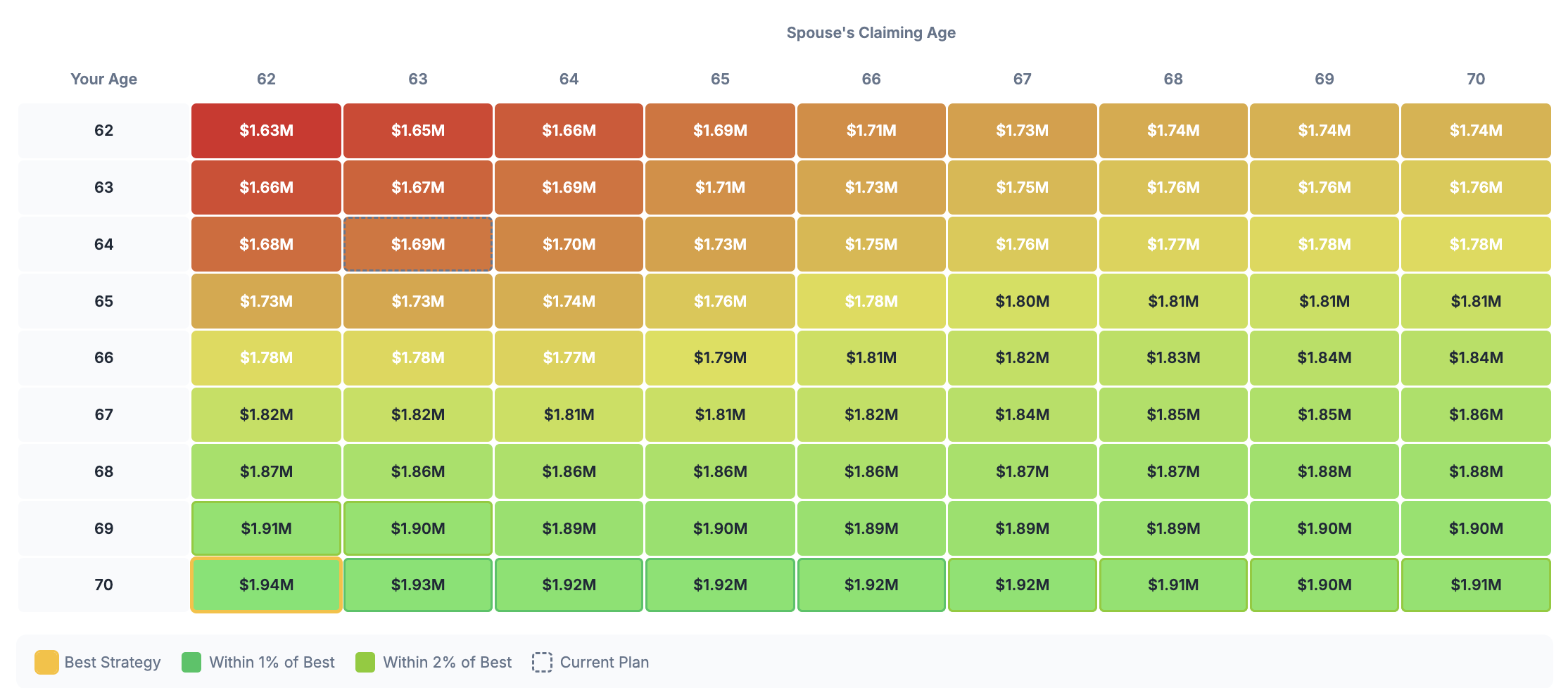
Calculates Total Lifetime Household Income
For each combination, the optimizer projects total Social Security income from the earliest claiming age through the end of the planning horizon (your life expectancy setting). It accounts for the fact that both spouses may have different life expectancies and that benefits continue only while the recipient is alive.
Ranks Strategies by Total Income
The optimizer ranks all tested combinations by total household income, so you can see which strategy produces the most income over your lifetime. It also highlights the top strategies so you can compare the best options without wading through all 81 combinations.
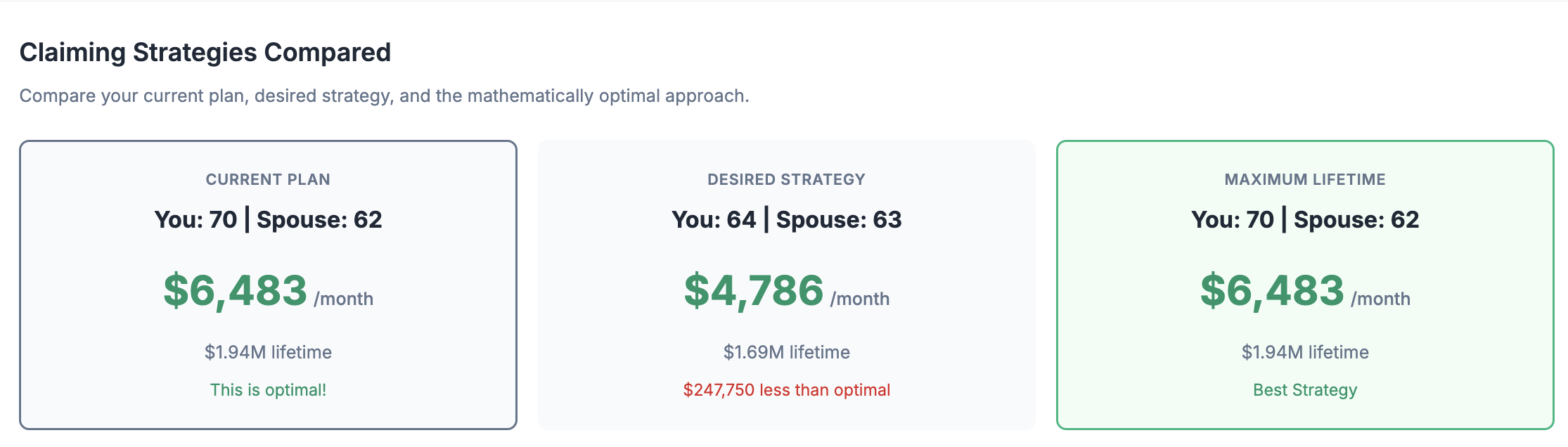
Cost-of-Living Adjustments (COLA)
Social Security benefits receive an annual Cost-of-Living Adjustment based on the Consumer Price Index. This adjustment compounds on your base benefit, which means a higher base benefit grows faster in absolute dollar terms.
How RetirePlanAI Models COLA
RetirePlanAI applies a default COLA rate of 3.8%, which is based on the historical average from 1975 through 2023. You can adjust this rate in your plan settings if you have a different expectation for future inflation adjustments. The COLA rate significantly affects long-term projections -- even a 1% difference in COLA compounds to a substantial amount over 20 to 30 years of retirement.
COLA is important for the claiming age decision because it amplifies the advantage of a higher base benefit. If you delay to 70 and receive a $2,480 base benefit, a 3.8% COLA adds $94 in the first year. If you had claimed at 62 with a $1,400 base benefit, the same COLA percentage adds only $53. Over time, this widening gap makes delayed claiming more attractive for people who expect to live well past break-even.
Applying Your Optimal Strategy
Once you have identified your preferred claiming strategy using the optimizer, you can apply it to your retirement plan with one click. This updates the Social Security claiming ages in your plan settings and recalculates all projections -- cash flow, portfolio balance, Monte Carlo simulations -- with the new strategy in place.
This integration is one of the key advantages of optimizing within RetirePlanAI rather than using a standalone Social Security calculator. You can see how the claiming decision ripples through your entire financial picture, not just the Social Security piece.
How Social Security Interacts With Your Broader Plan
Cash Flow Projections
Social Security income appears as a line item in your year-by-year cash flow projections. Before your claiming age, no Social Security income appears. After claiming, the benefit (adjusted for COLA each year) flows into your income, reducing the amount you need to withdraw from your portfolio.
The Bridge Years
If you delay Social Security, you need to fund your living expenses from other sources during the years before benefits begin. Your cash flow projections will reflect higher portfolio withdrawals during these bridge years, with withdrawals naturally decreasing once Social Security income starts. This means your portfolio balance may drop more quickly in the early years before stabilizing.
IRMAA Impact
Social Security income counts toward your Modified Adjusted Gross Income for IRMAA purposes. Up to 85% of your Social Security benefit can be included in MAGI, depending on your total income. This means a higher Social Security benefit (from delaying) can push you closer to or over IRMAA thresholds. RetirePlanAI accounts for this interaction when evaluating IRMAA. See IRMAA and Medicare-Aware Planning for more details.
Withdrawal Strategy Interaction
Your Social Security claiming age affects your withdrawal strategy timing and magnitude. Claiming early reduces the burden on your portfolio in the early years but may result in lower total income over time. Claiming late requires heavier early withdrawals but can significantly reduce portfolio pressure in later years. RetirePlanAI models these interactions automatically based on your chosen withdrawal strategy. See Withdrawal Strategies Explained for details on available strategies.
Common Tradeoffs to Consider
Claiming Early (Age 62)
Advantages: Immediate income, reduces early portfolio withdrawals, beneficial if you have health concerns that suggest a shorter life expectancy, allows you to preserve portfolio assets during potentially volatile early retirement years.
Disadvantages: Permanently reduced benefits, lower COLA growth in absolute terms, less longevity insurance if you live into your 90s.
Claiming Late (Age 70)
Advantages: Maximum monthly benefit, strongest longevity insurance, highest COLA growth, leaves more income for a surviving spouse (if applicable).
Disadvantages: Requires funding 8 bridge years from portfolio, higher portfolio withdrawal rates in early retirement, risk that you do not live long enough for delayed claiming to pay off.
Spousal Coordination: Split Strategy
Advantages: One spouse claims early to provide income while the other delays for maximum benefit. Balances current income needs with longevity protection.
Disadvantages: More complex to model, the early-claiming spouse locks in a lower benefit permanently.
Limitations
RetirePlanAI estimates Social Security benefits based on the monthly benefit amounts you enter. For the most accurate benefit estimates, check your Social Security Statement at ssa.gov. The optimizer models survivor benefits (the surviving spouse receives the higher of their own benefit or the deceased spouse's benefit), but it does not account for the earnings test that may reduce benefits if you claim before FRA while still working.
Additionally, the optimizer's ranking is based on total nominal household income. It does not discount for the time value of money or account for taxes on Social Security benefits. These factors can shift the optimal strategy slightly, but total household income is a reasonable starting point for most households. You can use RetirePlanAI's scenario comparison feature to explore how different strategies affect your after-tax retirement picture.