
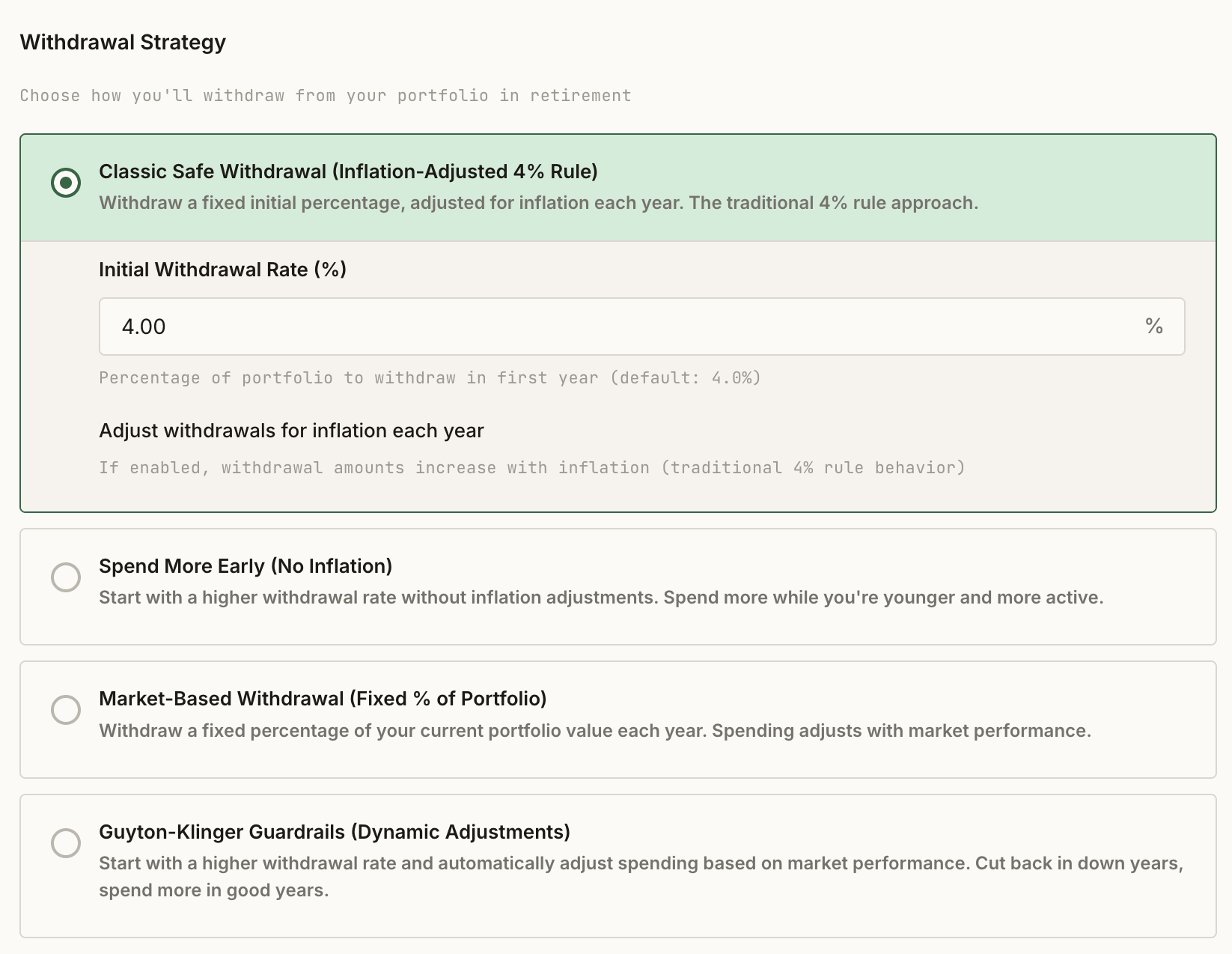
Most retirement planning focuses on accumulation -- saving and investing over decades. But the withdrawal phase is where the real complexity lives. How you draw down your portfolio determines whether your money lasts, how much income you can enjoy, and how much risk you carry year to year. RetirePlanAI supports five distinct withdrawal strategies and three account drawdown sequences. This guide explains each one, including the tradeoffs that matter.
Why Your Withdrawal Strategy Matters
Consider two retirees who each saved $1.5 million. One uses a rigid withdrawal approach and runs out of money at 87. The other uses a dynamic approach and still has $800,000 at 92. The difference is not how much they saved -- it is how they withdrew. Your withdrawal strategy determines:
- Income stability: How predictable is your monthly income?
- Portfolio longevity: How likely is it that your money outlasts you?
- Income adequacy: Can you actually live on what the strategy provides?
- Adaptability: How does the strategy respond when markets crash or surge?
No single strategy is best for everyone. The right choice depends on your risk tolerance, income flexibility, other income sources (Social Security, pensions), and how you feel about income variability.
Strategy 1: Classic Safe Withdrawal (The 4% Rule)
The 4% Rule is the most widely known withdrawal strategy, originating from William Bengen's 1994 research. It is simple, well-studied, and serves as a useful baseline even if you ultimately choose a different approach.
How It Works
In your first year of retirement, you withdraw 4% of your portfolio value. In each subsequent year, you take the same dollar amount adjusted for inflation, regardless of what the market does.
Example with a $1,000,000 portfolio:
- Year 1: Withdraw $40,000 (4% of $1,000,000)
- Year 2: Withdraw $41,200 ($40,000 adjusted for 3% inflation) -- even if the portfolio dropped to $900,000
- Year 3: Withdraw $42,436 ($41,200 adjusted for 3% inflation) -- regardless of portfolio value
RetirePlanAI Settings
The default withdrawal rate is 4.0%, but you can adjust it. You can also disable the annual inflation adjustment, which locks your withdrawal to a fixed dollar amount. Some retirees prefer this if they have inflation-adjusted income from other sources like Social Security or a pension with COLA.
Pros
- Simplicity -- easy to understand and implement
- Predictable income that rises with inflation
- Well-researched -- historically survived most 30-year retirement periods with a diversified portfolio
- Provides a clear, stable budget for annual spending
Cons
- Ignores market conditions entirely -- you withdraw the same amount whether your portfolio gained 25% or lost 25%
- In bad early markets (sequence-of-returns risk), continuing to withdraw can permanently damage your portfolio
- Conservative enough that many retirees die with significant unspent wealth -- the original research showed median terminal wealth of 2 to 3 times the starting portfolio
- The 4% rate was calibrated for 30-year retirements with a specific stock/bond allocation. If you retire early or expect a longer retirement, 4% may be too aggressive. If you retire later, it may be too conservative.
Strategy 2: Spend More Early
Research on actual retiree spending shows a pattern sometimes called the "retirement spending smile." People spend more in their 60s and early 70s (travel, hobbies, home projects), less in their mid-70s to mid-80s, and then more again in their late 80s and 90s (healthcare). The Spend More Early strategy aligns withdrawals with this natural pattern.
How It Works
You start with a higher withdrawal rate -- the default is 6.5% -- and optionally reduce it gradually over time, typically by about 0.5% per year. This front-loads your spending to the years when you are most likely to be active and enjoying retirement.
Example with a $1,000,000 portfolio:
- Age 65: Withdraw $65,000 (6.5%)
- Age 66: Withdraw approximately $60,000 (6.0% of remaining portfolio)
- Age 67: Withdraw approximately $55,500 (5.5% of remaining portfolio)
- The rate continues to decrease gradually over time
Pros
- Matches how people actually spend in retirement -- more early, less later
- Allows you to enjoy your most active years with higher income
- Reduces the problem of dying with too much unspent wealth
- For retirees with strong Social Security or pension income starting later, higher early withdrawals bridge the gap
Cons
- Higher early withdrawal rates increase the risk of portfolio depletion if markets perform poorly
- If you end up spending more, not less, in later years (extended care needs, for example), you may not have enough left
- Requires discipline to actually reduce spending as planned
- Less margin for error than the 4% rule
Strategy 3: Market-Based Withdrawal
The Market-Based strategy takes a fundamentally different approach: instead of withdrawing a fixed dollar amount, you withdraw a fixed percentage of your current portfolio value each year. This means your income moves up and down with the market.
How It Works
Each year, you withdraw a set percentage of whatever your portfolio is worth at that point. The default rate in RetirePlanAI is 4.5%.
Example with a $1,000,000 starting portfolio:
- Year 1: Portfolio is $1,000,000. Withdraw $45,000 (4.5%)
- Year 2: Portfolio grew to $1,050,000. Withdraw $47,250 (4.5%)
- Year 3: Portfolio dropped to $900,000. Withdraw $40,500 (4.5%)
The Key Property
Because you always take a percentage of what remains, your portfolio can never reach zero through withdrawals alone. If the portfolio drops to $200,000, you withdraw $9,000. If it drops to $50,000, you withdraw $2,250. The portfolio shrinks but never hits zero. This is a mathematically attractive property, but it comes with a practical cost: your income can drop to levels that are not livable.
Pros
- Portfolio cannot be depleted by withdrawals -- it will always have a remaining balance
- Automatically adjusts to market conditions -- you spend more in good years, less in bad years
- Simple to calculate and implement
- Can support a slightly higher withdrawal rate than the 4% rule because of the built-in adjustment mechanism
Cons
- Income is unpredictable and can vary significantly from year to year
- A major market downturn can cut your income by 30% or more in a single year
- Difficult to budget when you do not know next year's income
- While the portfolio never reaches zero, the income it produces can become insufficient for basic living expenses
- Retirees with fixed costs (mortgage, insurance, healthcare) may find the variability unworkable
Strategy 4: Guyton-Klinger Guardrails
Developed by Jonathan Guyton and William Klinger, this strategy attempts to combine the benefits of a higher initial withdrawal rate with dynamic adjustments that protect the portfolio. It uses "guardrails" -- upper and lower bounds -- to trigger spending adjustments.
How It Works
You start with an initial withdrawal rate (default 5.0% in RetirePlanAI) and set a guardrail width (default 20%). Each year, the tool calculates your current withdrawal rate (this year's withdrawal divided by current portfolio value). If that rate drifts too far from the initial rate, spending is adjusted:
- Upper guardrail: If your current withdrawal rate exceeds the initial rate plus the guardrail width (e.g., 5.0% + 20% = 6.0%), your spending is cut by the adjustment rate (default 10%). This happens when the portfolio has dropped and you are withdrawing too large a percentage. Following the original Guyton-Klinger research, this Capital Preservation Rule is suspended during the final 15 years of your planning horizon (based on your life expectancy); the Inflation Rule and the Prosperity Rule continue to apply in those years.
- Lower guardrail: If your current withdrawal rate falls below the initial rate minus the guardrail width (e.g., 5.0% - 20% = 4.0%), your spending is increased by the adjustment rate. This happens when the portfolio has grown and you are withdrawing too small a percentage.
- Within guardrails: If the current rate is between the guardrails, your withdrawal simply adjusts for inflation as normal.
A Practical Example
Starting with a $1,000,000 portfolio, 5.0% initial rate, 20% guardrails, and 10% adjustment rate:
- Year 1: Withdraw $50,000 (5.0% of $1,000,000)
- Year 2: Portfolio drops to $850,000. Inflation-adjusted withdrawal would be $51,500. Current rate: $51,500 / $850,000 = 6.06%. That exceeds the upper guardrail (6.0%), so spending is cut by 10%: $51,500 x 0.90 = $46,350.
- Year 3: Portfolio recovers to $950,000. Inflation-adjusted withdrawal would be $47,740. Current rate: $47,740 / $950,000 = 5.03%. Within guardrails, so no adjustment needed. Withdraw $47,740.
Pros
- Allows a higher initial withdrawal rate than the 4% rule (typically 5% to 5.5%)
- Dynamic adjustments protect the portfolio during downturns
- Captures upside during good markets by increasing spending
- Research suggests guardrails strategies have high success rates in historical simulations
- The adjustments are moderate (10% cuts or increases), not drastic
Cons
- More complex to understand and implement than simpler strategies
- Income can fluctuate, though less dramatically than the pure market-based approach
- Spending cuts during downturns may come at the worst time psychologically
- Requires annual recalculation and discipline to follow the rules
- The guardrail parameters (width and adjustment rate) significantly affect outcomes and can be hard to calibrate without testing
Strategy 5: Vanguard Dynamic Spending
Described in Vanguard's 2020 research paper "From assets to income: A goals-based approach to retirement spending," this strategy is a hybrid of two approaches above. It takes the percentage-of-portfolio idea from Market-Based withdrawals and the year-to-year stability of the Classic 4% Rule, and blends them by limiting how much your spending is allowed to change from one year to the next.
How It Works
Each year there are three steps:
- Compute a target: multiply your target withdrawal rate by your current portfolio balance -- exactly as Market-Based does.
- Build a band around last year's spending: take what you actually spent last year, adjust it for inflation, then set a ceiling 5% above that figure and a floor 2.5% below it.
- Spend the target, clamped to the band: if the target is above the ceiling, spend the ceiling; if it is below the floor, spend the floor; otherwise spend the target as is.
Year one has no prior spending to build a band around, so it is simply the target rate times the starting balance.
One point that is easy to misread: the ceiling and floor are limits on how much your inflation-adjusted spending may change from one year to the next. They are not withdrawal-rate bands, and they are not Guyton-Klinger guardrails. Guardrails watch your withdrawal rate and trigger a discrete 10% cut or raise when a threshold is crossed; Dynamic Spending never lets a single year's change exceed +5% or -2.5% in the first place.
RetirePlanAI Settings
The defaults are a 5.0% target withdrawal rate, a 5% maximum annual increase, and a 2.5% maximum annual decrease. All three are adjustable. Vanguard's paper used +5% and -2.5% as its example limits and a 4% withdrawal rate in its worked example, but the withdrawal rate is an input you choose, not part of the rule itself.
A Practical Example
Using the numbers from Vanguard's paper -- a $1,000,000 portfolio, a 4% target rate, and 3% inflation:
- Year 1: Withdraw $40,000 (4% of $1,000,000).
- Year 2 band: Last year's $40,000 adjusted for 3% inflation is $41,200. The ceiling is $43,260 (+5%) and the floor is $40,170 (-2.5%).
- If the portfolio rose to $1,150,000: The 4% target is $46,000, which is above the ceiling, so you spend $43,260.
- If the portfolio fell to $950,000: The 4% target is $38,000, which is below the floor, so you spend $40,170.
- If the portfolio is $1,050,000: The 4% target is $42,000, which is inside the band, so you spend $42,000 as is.
Pros
- Spending follows the market, but gradually -- no double-digit swings in a single year
- More spending stability than Market-Based, more responsiveness to markets than the Classic 4% Rule
- Captures a share of good markets through the +5% ceiling without locking in an unsustainable amount
- Easy to budget around: you always know next year's spending will land within a narrow band of this year's
Cons
- Because annual cuts are capped at 2.5%, spending falls more slowly than the portfolio does in a long downturn -- the portfolio can still be depleted
- After a strong run, the ceiling can leave you spending less than the portfolio could support for several years
- Requires tracking last year's spending and recalculating annually
- The three parameters interact; the target rate in particular determines whether the band drifts toward or away from a sustainable level over time
Who It Suits
Retirees who want their spending to follow the market but cannot tolerate double-digit swings, and who have some flexible spending in their budget that can absorb small annual adjustments.
Account Drawdown Sequencing
In addition to choosing how much to withdraw, you need to decide which accounts to withdraw from first. If you have money in taxable brokerage accounts, tax-deferred accounts (traditional 401(k) or IRA), and tax-free accounts (Roth IRA or Roth 401(k)), the order in which you tap them has significant tax implications. RetirePlanAI supports three sequencing strategies:
Conventional Wisdom
Order: Taxable accounts first, then tax-deferred (401(k)/IRA), then tax-free (Roth)
This is the most widely recommended sequence. The logic is:
- Taxable accounts may generate capital gains and dividends whether you withdraw or not, so using them first minimizes ongoing tax drag
- Tax-deferred accounts continue to grow tax-free while you spend down taxable accounts
- Roth accounts grow completely tax-free and are preserved as long as possible, maximizing their tax advantage
The downside: tax-deferred accounts can grow very large, leading to substantial Required Minimum Distributions (RMDs) starting at age 73 that may push you into higher tax brackets or trigger IRMAA surcharges.
Roth Early
Order: Taxable accounts first, then Roth, then tax-deferred
This less common approach draws from Roth accounts before tax-deferred accounts. The rationale:
- By spending Roth funds earlier, you preserve tax-deferred accounts, which are then subject to RMDs
- Wait -- that sounds backwards. Why would you spend tax-free money before taxable money?
- The logic applies in specific situations: if your tax-deferred accounts are modest and RMDs will be small, or if you expect your tax rate to be lower in the future, spending Roth first and letting tax-deferred accounts benefit from continued tax deferral can make sense
- This is the least common strategy and is primarily useful for specific tax planning situations
Proportional
Order: Withdraw from all account types proportionally based on their current balance
If 40% of your portfolio is in taxable accounts, 35% is in tax-deferred, and 25% is in Roth, each withdrawal draws 40/35/25 from each bucket. The rationale:
- Maintains a consistent tax allocation throughout retirement
- Avoids the "tax time bomb" of having all your money in one type of account late in retirement
- Produces a more predictable tax situation year over year
- Provides partial tax diversification in each withdrawal
The downside: you lose some of the tax optimization that comes from strategically ordering withdrawals. You may pay more tax in early years than the conventional wisdom approach, while getting less tax-free growth from your Roth accounts.
How to Choose Your Strategy
There is no universally correct answer, but here are some guidelines:
- If you value simplicity and predictability: Start with the Classic 4% Rule. It gives you a clear, stable income and is easy to follow.
- If you want to enjoy early retirement fully and have other income sources later: Consider Spend More Early, especially if Social Security or a pension will cover a significant portion of your later expenses.
- If you can tolerate income variability and want portfolio protection: Market-Based withdrawals ensure your portfolio lasts, but you need the flexibility to adjust spending.
- If you want a higher initial withdrawal with built-in safeguards: Guyton-Klinger Guardrails offer a middle ground between the 4% rule and fully variable approaches.
- If you want spending to track the market without sharp swings: Vanguard Dynamic Spending caps each year's change at +5% / -2.5% after inflation -- a smoother ride than Market-Based with more responsiveness than the 4% rule.
Use Scenarios to Compare
The best way to evaluate withdrawal strategies is not to choose one in the abstract but to test them against your specific financial situation. RetirePlanAI's scenario comparison feature lets you create multiple plans -- each with a different withdrawal strategy -- and compare them side by side. You can see how each strategy affects your income, portfolio balance, and probability of success across your full retirement horizon. See Retirement Scenarios and Side-by-Side Comparisons for details on how to set this up.
Combine With Monte Carlo Testing
Each withdrawal strategy responds differently to market volatility. Running a Monte Carlo simulation with each strategy shows you the range of possible outcomes, not just the average case. A strategy that looks optimal in a straight-line projection may perform very differently across 5,000 randomized market scenarios.