
For many Americans, their home is the single most valuable asset they own. According to Federal Reserve data, home equity accounts for roughly one-third of total household wealth for retirees. Despite this, many retirement planning tools treat real estate as an afterthought -- or ignore it entirely. RetirePlanAI includes real estate as a first-class component of your financial picture, covering property tracking, appreciation modeling, mortgage payoff timelines, planned home sales, and rental income. This guide explains each feature and how they work together.
Physical Asset Tracking
RetirePlanAI lets you track physical assets including real estate (primary homes, vacation homes, investment properties), vehicles, and other valuable property. For each asset, you enter:
- Asset name and type: Identify what the asset is (e.g., "Primary Home," "Lake Cabin," "2022 Toyota Camry")
- Current market value: Your best estimate of what the asset is worth today
- Ownership: Whether the asset belongs to you or your spouse
These assets appear in your Financial Overview as part of your net worth calculation. Physical assets are tracked separately from investment accounts because they serve a different purpose -- you live in your home or use your car, so their value is not readily available for spending. But they are still part of your total financial picture, and understanding your net worth breakdown helps you see how concentrated your wealth is across different asset types.
Why Track Non-Liquid Assets?
Even if you never plan to sell your home, tracking its value matters for several reasons:
- Net worth clarity: Knowing that 45% of your net worth is in your home and only 40% is in investable assets gives you a clearer picture of your retirement readiness than looking at investment accounts alone
- Insurance adequacy: Your home value estimate helps you verify that your insurance coverage is appropriate
- Estate planning: Physical assets are part of your estate, and understanding their projected value helps with planning for heirs
- Optionality: Plans change. Tracking your home value now means that if you later decide to sell, the data is already in your plan
Housing Appreciation
Real estate values change over time, and RetirePlanAI projects your home value forward using an appreciation rate. The default rate is 5.13% annually, which is based on US housing price data from 2001 through 2025.
What the Default Rate Reflects
The 5.13% default is a national average that includes the housing boom, the 2008-2009 crash, and the strong recovery that followed. It is a nominal rate, meaning it includes inflation. In real (inflation-adjusted) terms, housing appreciation has historically averaged closer to 1-2% above inflation over long periods, though with significant regional variation.
Should You Adjust the Default?
You can change the appreciation rate to match your expectations. Consider adjusting it if:
- Your market differs from the national average: Coastal and urban markets have historically appreciated faster. Rural markets and some Midwest regions have appreciated more slowly.
- You are conservative by nature: Using 3-4% instead of 5.13% gives you a more cautious projection. If the plan works at lower appreciation, it will work even better if your home appreciates faster.
- You have a specific view on inflation: If you expect lower inflation, housing appreciation may also be lower in nominal terms.
A word of caution: do not project unrealistic appreciation rates. The period from 2012 to 2024 saw unusually strong housing appreciation in many markets. Counting on 8-10% annual appreciation indefinitely is optimistic and could lead to overestimating your future wealth.
Mortgage Tracking
If you have a mortgage, RetirePlanAI models it as part of your financial picture. You enter:
- Current mortgage balance: What you still owe
- Monthly payment: Your principal and interest payment
- Interest rate: Your current mortgage rate
How the Tool Uses Mortgage Data
From these inputs, RetirePlanAI calculates your mortgage payoff timeline using standard amortization. This matters for retirement planning in two ways:
- Expense projections: Your mortgage payment is factored into your expenses until the mortgage is paid off. Once the mortgage is gone, your expenses drop by that monthly amount. For many retirees, mortgage payoff is a significant expense reduction that changes their retirement income needs.
- Home sale calculations: If you plan to sell your home, the tool needs to know your remaining mortgage balance at the time of sale to calculate your net equity (sale price minus remaining mortgage).
Carrying a Mortgage Into Retirement
There is ongoing debate about whether to pay off your mortgage before retirement. The financial math depends on your mortgage interest rate versus your expected investment returns. If your mortgage rate is 3.5% and your portfolio earns 7%, the math favors keeping the mortgage. But math is not the only consideration -- many retirees value the peace of mind of a paid-off home, and eliminating a large fixed monthly expense reduces the income you need to generate from your portfolio.
RetirePlanAI does not tell you which approach is better -- that depends on your personal preferences. But by including the mortgage in your plan, you can see exactly how it affects your cash flow and how your expenses change once it is paid off.
Home Sale Planning
Many retirees plan to sell their home at some point -- to downsize, relocate to a lower-cost area, or move into a retirement community. A home sale can inject a significant amount of cash into your retirement plan, but the timing and mechanics matter.
How Home Sales Work in RetirePlanAI
When you set up a planned home sale, you specify when you expect to sell. RetirePlanAI then:
- Projects the home value at sale: Using your current home value and the appreciation rate, the tool calculates what your home will likely be worth at the planned sale date. For example, a $400,000 home appreciating at 5% annually would be worth approximately $651,000 in 10 years.
- Calculates remaining mortgage balance: Using the amortization schedule, the tool determines how much you will still owe at the sale date. If your mortgage will be paid off before the sale, the remaining balance is zero.
- Determines net equity: The projected sale price minus the remaining mortgage balance equals the net cash you receive from the sale. This is the amount that flows into your retirement plan as available funds.
Where the Proceeds Go
Net home sale proceeds appear in your cash flow projections at the planned sale date. This one-time influx of cash can significantly extend your portfolio longevity or increase your spending capacity. For retirees who are downsizing, the combination of a cash infusion and reduced housing expenses (no mortgage, lower maintenance, lower property taxes) can meaningfully change their retirement outlook.
Planning Considerations for Home Sales
- Timing matters: Selling too early means less appreciation. Selling too late means you may be managing a home that has become burdensome. Consider your energy level and maintenance capacity, not just the financial math.
- Transaction costs: Real estate commissions, closing costs, and moving expenses can consume 6-10% of the sale price. Factor these into your net equity expectations.
- Replacement housing: If you are downsizing rather than moving in with family, you need to account for the cost of your next home. The net financial benefit is the equity from the sale minus the cost of the new home.
- Emotional factors: Your home may have significant sentimental value. Financial projections cannot capture the emotional cost of selling a family home. This is a deeply personal decision that the numbers can inform but not make for you.
Rental Income
If you own investment properties or plan to rent part of your home, rental income can be a valuable retirement income stream. In RetirePlanAI, rental income is tracked as an income stream with several configurable properties:
- Monthly amount: How much rental income you receive per month
- Start and end ages: When the rental income begins and when it ends (for example, you might plan to sell the rental property at age 75)
- Inflation adjustment (COLA): Whether the rental income increases with inflation over time or stays at a fixed dollar amount. Rents generally do increase with inflation over long periods, so enabling COLA is usually appropriate for long-term projections.
How Rental Income Fits Into Your Plan
Rental income appears as a line item in your cash flow projections alongside other income sources like Social Security, pensions, and portfolio withdrawals. It reduces the amount you need to withdraw from your investment portfolio, which extends portfolio longevity.
One important note: rental income counts toward your Modified Adjusted Gross Income (MAGI), which means it can affect your tax bracket, the taxation of Social Security benefits, and IRMAA surcharges on Medicare premiums. If you have significant rental income, be sure to consider these interactions when planning your overall income strategy.
How Real Estate Integrates With Your Full Plan
Financial Overview and Net Worth
Physical assets (including real estate) appear in your Financial Overview as a distinct category. You can see your net worth broken down into investment accounts, physical assets, and liabilities (including mortgages). This gives you a complete picture of where your wealth is concentrated.
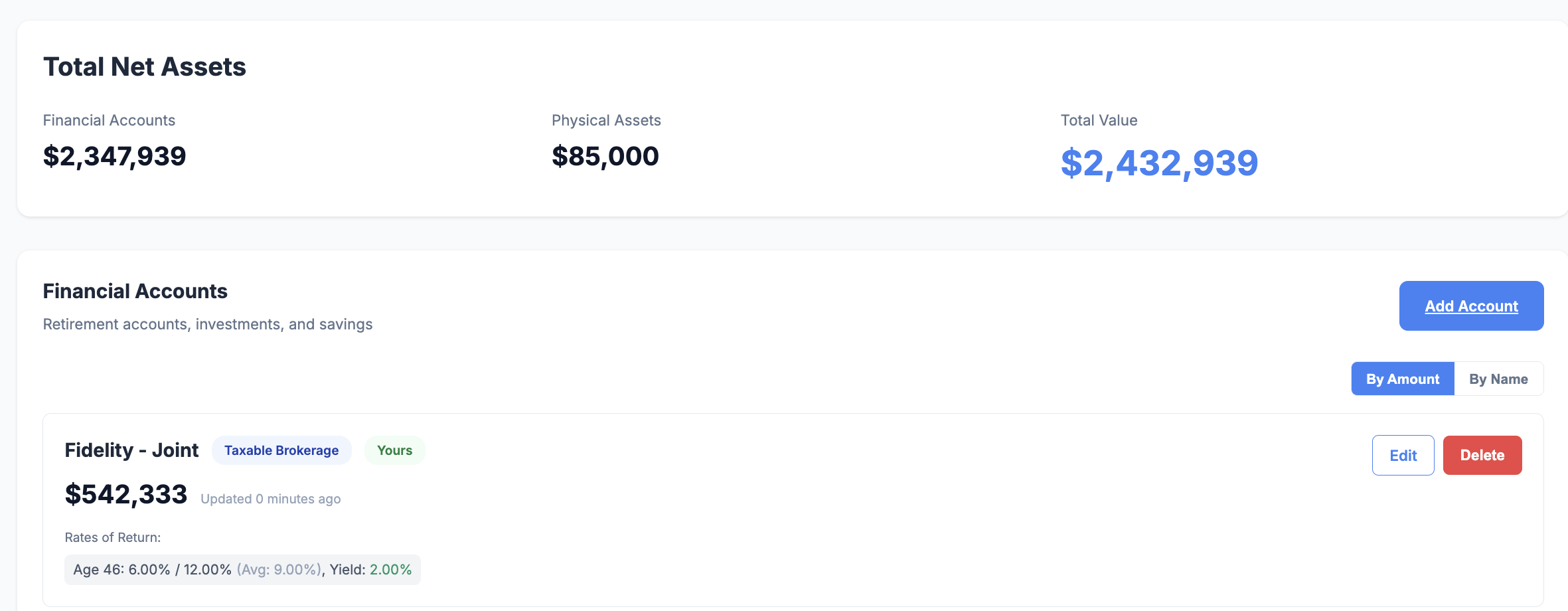
Home Equity vs. Investable Assets
It is important to understand that home equity is not the same as investable assets. You cannot spend your home equity without selling your home or taking out a home equity loan (which RetirePlanAI does not model). When the tool calculates your withdrawal rates and portfolio projections, it uses your investable assets -- not your total net worth including home equity. This is a more conservative and accurate approach to retirement income planning.
Mortgage Payments in Expense Projections
Your mortgage payment appears in your expense projections until the calculated payoff date. After payoff, that expense disappears from your projections, which may change your required income and withdrawal amounts. This transition is handled automatically -- you do not need to create separate pre-payoff and post-payoff expense budgets.
Home Sale Proceeds in Cash Flow
If you have a planned home sale, the net proceeds appear as a one-time income event in your cash flow projections at the planned sale date. This can significantly change your portfolio trajectory for the remaining years of your plan.
Practical Tips for Real Estate in Retirement Planning
Be Honest About Your Home Value
It is natural to be optimistic about what your home is worth. For planning purposes, use a realistic current market value. Check recent comparable sales in your area, or get a professional appraisal if your home represents a large portion of your net worth. An inflated starting value will compound through the appreciation rate and overstate your projected wealth.
Consider Multiple Scenarios
If a home sale is central to your retirement plan, consider creating scenarios with different sale dates and appreciation rates. What happens if you sell at 68 instead of 72? What if appreciation is 3% instead of 5%? If your plan only works with optimistic assumptions, that is a warning sign.
Do Not Count on Your Home as a Retirement Fund
Home equity is valuable, but it is illiquid and comes with significant transaction costs. A plan that depends entirely on selling your home to fund retirement is fragile. Ideally, your investment portfolio should be sufficient to cover your needs, with the home sale providing additional cushion or lifestyle enhancement.
Account for All Housing Costs
When comparing "stay in current home" versus "downsize" scenarios, include all costs: property taxes, insurance, maintenance (typically 1-2% of home value annually), utilities, and HOA fees. The true cost of homeownership is often higher than the mortgage payment alone. Make sure these are reflected in your budget line items so your projections are realistic.